

KEY FOCUS AREA
redistricting


Virginia has the unceremonious distinction of being home to the first gerrymander in American history. Patrick Henry drew an opponent out of his Congressional district in 1788, and politicians repeated that exercise unchecked until Virginia voters approved Amendment 1 in 2020, over 230 years later.
Ultimately, Virginia’s 2021 districts were lauded by a long list of nonpartisan analysts, including the Campaign Legal Center, FiveThirtyEight, the University of Virginia’s Center for Politics, the Brennan Center for Justice, and the Princeton Gerrymandering Project, who said that Virginia “has some of the fairest district maps in the country.”
2026 Redistricting Amendment

Voters will answer Yes or No to the following ballot question:
Should the Constitution of Virginia be amended to allow the General Assembly to temporarily adopt new congressional districts to restore fairness in the upcoming elections, while ensuring Virginia's standard redistricting process resumes for all future redistricting after the 2030 census?
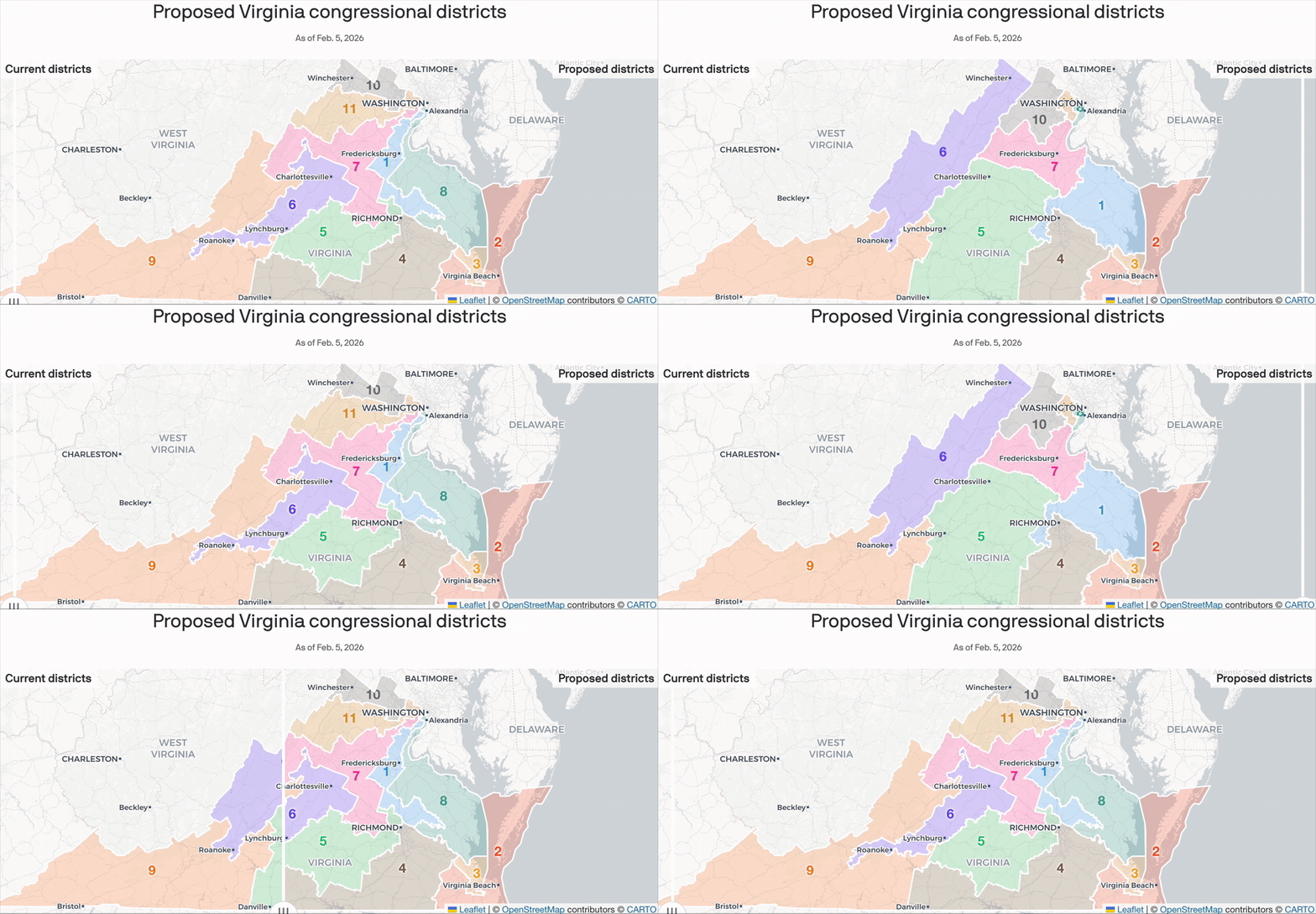
Data: Virginia Legislative Information System; Map: Jacque Schrag/Axios
VOTER INFORMATION
Early voting has begun. Voters have between now and April 21 to weigh in on this issue.
Deadlines:
Register to Vote/Update Registration: 4/14/2026
Early in-person voting: 3/6/2026 through 4/18/2026
Apply for ballot to be mailed to you: through 4/10/2026
Learn more about where, when, and what you need to vote on our Civic Engagement page.

We thought the work from last decade would be enough to keep Virginia out of the escalating national “gerrymandering wars,” but we were wrong. See below for information about the upcoming voter referendum on redistricting.
In response to the national gerrymandering efforts across several states, Democratic leaders in Virginia have proposed a new amendment to the state constitution that would allow the General Assembly to redraw Congressional districts mid-decade. This is a departure from previous decades and a temporary bypassing of the Virginia Redistricting Commission. Voters will get to decide whether to adopt this change in a special April 21 election.
WHAT DOES THE NEW AMENDMENT DO?
If voters approve this measure on April 21, the General Assembly will have the power to redraw the current Congressional maps before the 2026 mid-term elections. Democratic Party leaders have already made the proposed maps public. The amendment language specifies that the ability to redistrict in the middle of the decade is contingent on another state doing so first. It also specifies that this ability only applies to elections before the 2030 US Census, meaning that Virginia mapmaking will once again be the responsibility of the Redistricting Commission in 2031.
WHAT DOES THE NEW AMENDMENT NOT DO?
The amendment does not eliminate the Redistricting Commission. It also does not affect legislative districts (those that determine where members of the General Assembly are elected.)
TIMELINE OF LEGAL CHALLENGES
October 2025 -
Amendment passes the General Assembly.
January 2026 -
A Tazewell County Circuit Court judge blocks the amendment effort. Judge Jack Hurley rules that the legislature’s process for advancing the amendment was invalid and halts the redistricting effort. See the ruling here.
Democratic leaders announced they would appeal the ruling.
February 2026 -
The Republican National Committee (RNC) and GOP leaders file a new lawsuit arguing, among other things, that the ballot language passed by the legislature is misleading.
Judge Jack Hurley issues a temporary restraining order, preventing election officials from proceeding with the referendum.
Supreme Court of Virginia (SCOVA) rules that the process could continue and would hear the appeal and rule on the merits of the case after the referendum was decided on by the voters.
February-March 2026 -
SCOVA issues additional orders allowing early voting and election preparations to move forward while the case remains pending.
Where do we go from here?
Until national policies change, gerrymandering remains a potential political weapon. UpVote urges current and hopeful representatives to support legislation like the Fair Representation Act, which would end Congressional gerrymandering and even the national playing field. In the meantime, we will continue to work toward structural reforms - including ranked choice voting and proportional representation - that offer durable solutions that reduce the power of maps to distort representation.
Stay in the loop with UpVote Virginia


Additional Resources